
Annalise is a doctoral student in the Clinical Psychology PhD program at the University of Oregon.
Throughout my academic career, I hope to contribute to a deeper understanding of the underlying mechanisms that contribute to the onset and maintenance of serious mental illness. As I navigate this diverse landscape of research, my overarching goal is to add insight on the pathway toward more accurate clinical diagnoses and interventions, whilst leveraging the insights gained from clinical practice. I care deeply about contributing to my community using person-centered approaches, and believe this can be better represented in the research space. I look forward to developing a program and career where my various pursuits continue to inform each other for the betterment of my research, practice, and community.
Mixed-methods designs allow me to think creatively about how research can more seamlessly translate into clinical care.
Clinical Diagnosis
Personality
Mood Disorders
Emotion Regulation
Keywords
Cognitive/Reasoning Biases
Psychosis
Psychopathology
Empathy
Skills
RStudio
MATLab
Qualtrics
E-Prime
Github
NIH NDA Data Submission
Clinical Interviews w/ SMI Populations
Manuscript Writing
Offsite/International Collaboration
Current Research
On Identity and Psychotic-like Experiences in Clinical High Risk
I am currently a first-year doctoral student in the CARE Lab at the University of Oregon. Under the mentorship of Dr. Tina Gupta, I hope to develop a research program that assesses the ways in which emotion and identity intersect for individuals at high risk for developing serious mental illness.
Past Research
On Cognition, Affect, and Persecutory Delusions in Psychosis
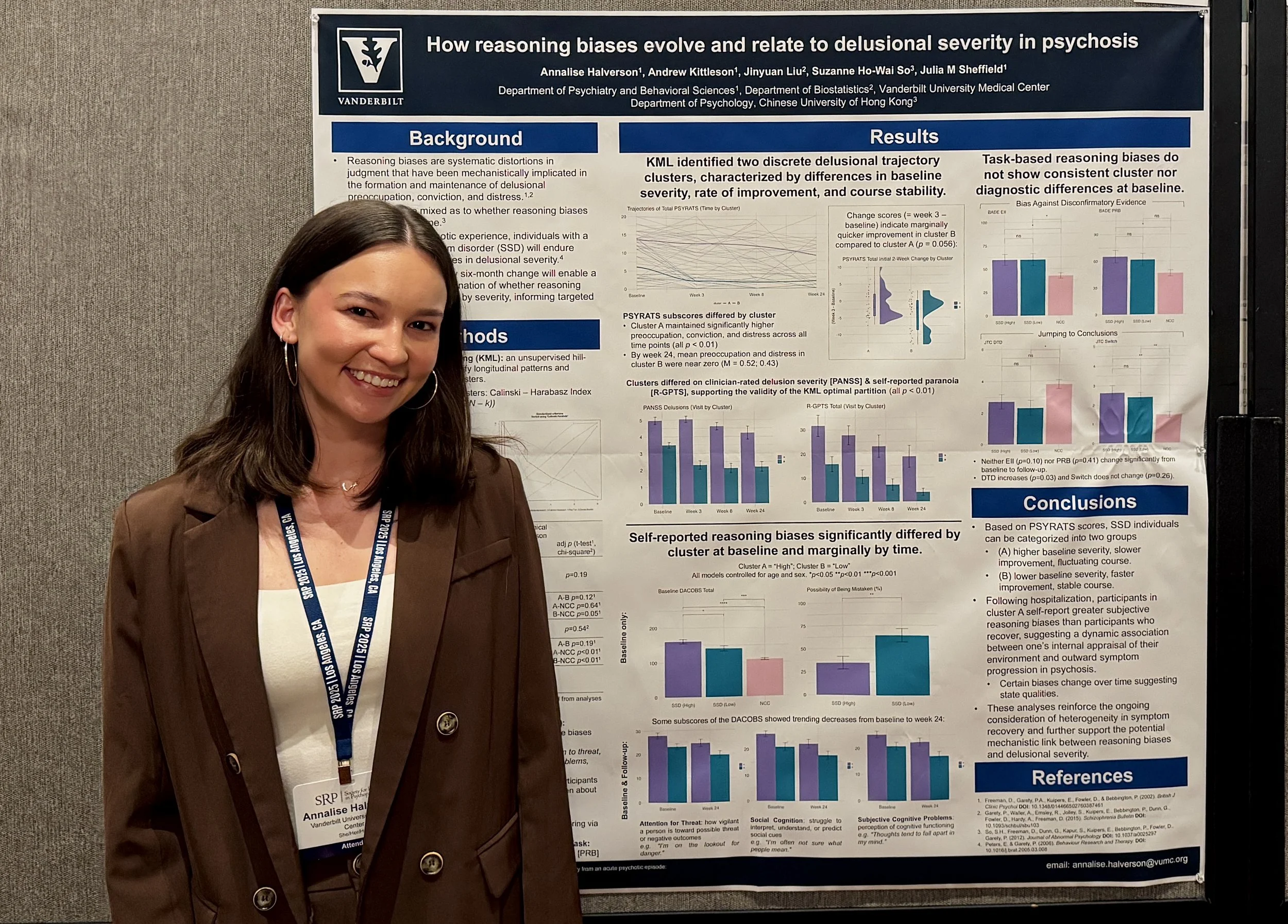
Led by Dr. Julia Sheffield at Vanderbilt University Medical Center, our team aimed to elucidate the psychological, cognitive, and neurobiological processes that contribute to psychotic experiences. My primary effort was toward a CBTp clinical trial that investigated the mechanisms of belief updating following psychotherapy. Here, I co-led recruitment, managed complex data analysis, and headed NIH NDA data submission. With participants, I administered various structured clinical interviews such as the Positive and Negative Syndrome Scale (PANSS) and Psychotic Symptom Rating Scale (PSYRATS).
On Psychopathy, Borderline Personality Disorder, and Alexithymia
At the Social Cognitive Neuroscience (SCN) Lab within the University of Chicago, I focused on reshaping the classification of psychopathy. My research culminated in a comprehensive thesis titled: 'Locating the Crossroads of Psychopathy, Borderline Personality Disorder, and Emotion as it Applies to Incarcerated Women.' Here, I dove into the intricacies of emotional understanding, weaving together the classifications of psychopathy and the complexities of borderline personality disorder, within the unique context of incarcerated women. My hope here was to not only contribute to the academic discourse, but also to foster a more compassionate and informed approach to understanding the psychological landscape of those within the criminal justice system. Inspired by Dr. Decety's guidance, I am committed to both unraveling the intricate complexities of these psychological phenomena as well as addressing the inherent gender biases associated with their diagnosis. I aspire to contribute meaningfully to our evolving picture of the human mind and foster a more inclusive and equitable approach to psychological research.
On Schizophrenia, Bipolar Disorder, and Psychosis
As an undergraduate at the University of Hawai‘i, I had the privilege of working on two unique projects. Under Dr. David Cicero, my research endeavors were centered around early onset schizophrenia, as well as the broader spectrum of disorders related to psychosis. Motivated by a deep curiosity about the intersections of mental health and societal outcomes, I dedicated myself to a comprehensive exploration. This journey led to the creation of a detailed literature review titled: 'An Illuminative Exploration of Criminality and Violence in Bipolar Disorder.' This work not only expanded my understanding of mental health complexities, but also inspired a commitment to contributing valuable insights to the interdisciplinary discourse surrounding mental health and its societal implications.
Under the mentorship of Dr. Susana Helm at the John A. Burns School of Medicine, I engaged in an independent project titled: 'Evidence of Elevated Substance Use in High-Need, Low-Resource Populations: A Review of the Publicly Available Literature.' This endeavor was particularly meaningful for me as it grappled directly with populations in my hometown. The project inspired me to pursue topics that resonate with the needs of my community, cultivating a passion for research that holds the potential for direct and purposeful impact on the well-being of those around me.